United in disagreement: Analyzing policy networks in EU policy making
Externe Veröffentlichung 24. März 2023 Dennis Abel / Armin Mertens in Review of Policy Research United in disagreement: Analyzing policy networks in EU policy making
Shared belief systems are generally assumed to forge policy networks. Empirical evidence whether and to what extend shared policy core beliefs create ally networks and under which circumstances shared policy core beliefs are not necessary to form these networks, however, is limited.
Der Link wurde zu Ihrer Zwischenablage hinzugefügt!
Dennis Abel / Armin Mertens in Review of Policy Research Institut der deutschen Wirtschaft (IW)
Shared belief systems are generally assumed to forge policy networks. Empirical evidence whether and to what extend shared policy core beliefs create ally networks and under which circumstances shared policy core beliefs are not necessary to form these networks, however, is limited.
Based on a novel inferential network approach in combination with mediation analysis, this study investigates the role of belief systems as a link between interest group type and policy preference congruence, ultimately leading to ally networks in the European Union. In order to measure the intervening effect of policy core beliefs, automated text analysis is used. Our results suggest that shared policy core beliefs are a strong mediator for members of the same interest group. In addition, “strange bedfellow” networks between NGOs and businesses do, in fact, lack belief congruence and emerge on issues with low potential for intergroup conflict. This paper makes a contribution to our understanding of ally network formation and adds to the emerging line of research which combines quantitative text with inferential network analysis.
IW-Report Nr. 45 29. Oktober 2026 Alexander Radunz / Gero Kunath
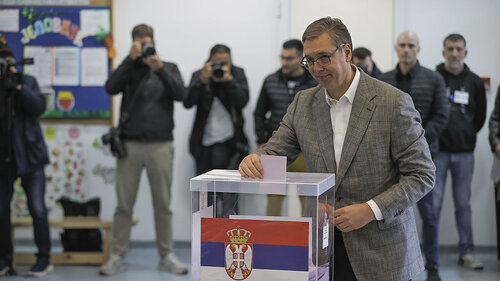
Go West? Serbia under Vučić
Aleksandar Vučić stand seit 2014 an der Spitze Serbiens, zunächst als Ministerpräsident und ab 2017 als Präsident, bis seine Amtszeit im Oktober 2026 mit einer vernichtenden Niederlage gegen die „Studentenliste“ endete. Der vorliegende Bericht bewertet die politische und wirtschaftliche Bilanz seiner zwölfjährigen Amtszeit.
Gastbeitrag 15. Oktober 2026 Michael Hüther im SZ Dossier
Die Transaktionskosten der Geopolitik bleiben hoch
IW-Direktor Michael Hüther analysiert im SZ Dossier Geoökonomie, wie Trumps Zollpolitik, Chinas Machtstreben und Russlands imperialer Anspruch die Weltordnung verändern. Europa müsse seine Verteidigungsfähigkeit stärken und sich auf hohe Transaktionskosten einstellen.
Diese Website verwendet notwendige Cookies zur Sicherstellung des Betriebs der Website. Sie können Tracking erlauben oder ablehnen. Wenn Sie Tracking erlauben, wird Matomo mit Cookies eingesetzt. Detaillierte Informationen über den Einsatz von Cookies finden Sie in unseren Datenschutzhinweisen.
Achtung: Sie nutzen einen veralteten Browser!
Bitte wechseln Sie zu einem modernen Browser (z.B. Google Chrome, Firefox oder Microsoft Edge), um in den Genuss des besten Nutzererlebnisses zu kommen.
 Institut der deutschen Wirtschaft (IW)