Free and Fair Trade Club – Deeper Cooperation Between the EU and the CPTPP
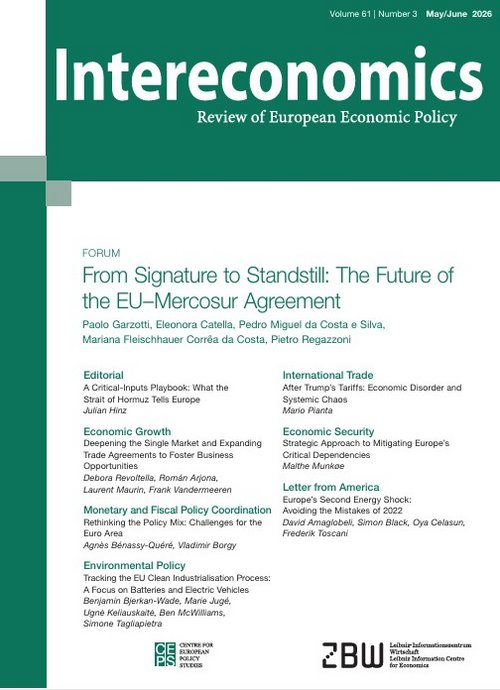
Externe Veröffentlichung 13. Juli 2026 Jürgen Matthes in Intereconomics Free and Fair Trade Club – Deeper Cooperation Between the EU and the CPTPP
The European Union and the Comprehensive and Progressive Agreement for Trans-Pacific Partnership should build a lasting cooperation platform, which could be named the Free and Fair Trade Club, in order to achieve various geostrategic aims.
Der Link wurde zu Ihrer Zwischenablage hinzugefügt!
Jürgen Matthes in Intereconomics Institut der deutschen Wirtschaft (IW)
The European Union and the Comprehensive and Progressive Agreement for Trans-Pacific Partnership should build a lasting cooperation platform, which could be named the Free and Fair Trade Club, in order to achieve various geostrategic aims.
In addition to free and fair trade, its guiding principles should include voluntary cooperation, variable geometry and open plurilateralism. Pooling the economic weight of Free and Fair Trade Club members’ markets would create a power base that these middle powers could leverage in relations with the great powers, the United States and China, in the medium to longer term.
The US and China are undermining the rules-based international order by using power politics and by employing coercive measures. The US uses blunt tariff and security threats, and thus projects the power of its market size and military might in order to force one-sided and unbalanced trade and investment concessions from partners with an aggressive focus on “America First” objectives.
China also uses coercive measures by exploiting its near monopoly in the production of important and often critical raw materials to the serious detriment of affected partners. Moreover, China’s state capitalism undermines the world trading order by using loopholes in the multilateral trade rules framework. Massive economic distortions – that emanate from outsized direct and indirect subsidies in the Chinese economy and from a large undervaluation of its currency – contribute to the record merchandise trade surplus of China. This beggar-thy-neighbour policy comes at the costs of its trading partners and hollows out their industrial bases.
Furthermore, the US and China defy international law: the US does so in Venezuela and Iran, and China does so by acting aggressively in the South China Sea and by threatening Taiwan. Both countries propagate a world in which might makes right.
Resilienz im Epochenbruch: Epochenbruch in den transatlantischen Wirtschaftsbeziehungen und die Suche nach neuen Partnern
Wir laden Sie herzlich ein zu einer weiteren Folge der virtuellen IW-Veranstaltungsreihe „Resilienz im Epochenbruch“ zum Thema „Epochenbruch in den transatlantischen Wirtschaftsbeziehungen und die Suche nach neuen Partnern”.
China-Handel: Höchste Zeit, dass die EU sich zu wehren lernt
Deutschland und Frankreich fordern vor der entscheidenden China-Reise von EU-Handelskommissar Šefčovič eine handelspolitische Allzweckwaffe gegen Marktverzerrungen. Der Vorstoß ist richtig.
Diese Website verwendet notwendige Cookies zur Sicherstellung des Betriebs der Website. Sie können Tracking erlauben oder ablehnen. Wenn Sie Tracking erlauben, wird Matomo mit Cookies eingesetzt. Detaillierte Informationen über den Einsatz von Cookies finden Sie in unseren Datenschutzhinweisen.
Achtung: Sie nutzen einen veralteten Browser!
Bitte wechseln Sie zu einem modernen Browser (z.B. Google Chrome, Firefox oder Microsoft Edge), um in den Genuss des besten Nutzererlebnisses zu kommen.

 Institut der deutschen Wirtschaft (IW)