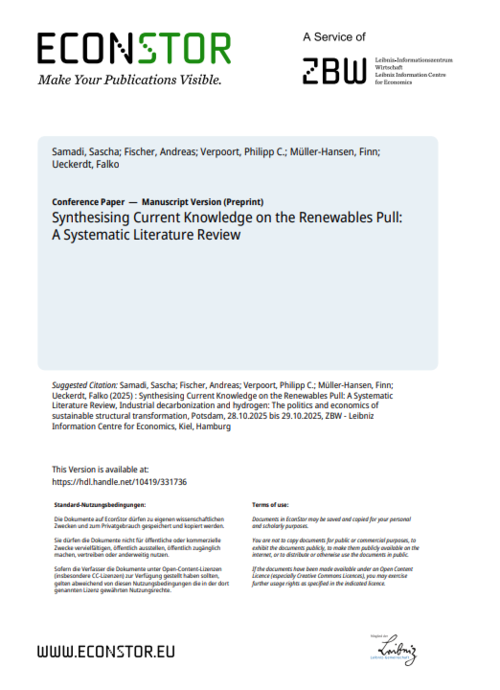
Synthesising Current Knowledge on the Renewables Pull: A Systematic Literature Review
Externe Veröffentlichung 27. November 2025 Sascha Samadi* / Andreas Fischer / Philipp C. Verpoort* / Finn Müller-Hansen* / Falko Ueckerdt* in Econstor Synthesising Current Knowledge on the Renewables Pull: A Systematic Literature Review
With the transition to renewable energy, global production cost patterns for industrial materials and products are shifting, potentially creating what has been termed the renewables pull.
Der Link wurde zu Ihrer Zwischenablage hinzugefügt!
Sascha Samadi* / Andreas Fischer / Philipp C. Verpoort* / Finn Müller-Hansen* / Falko Ueckerdt* in Econstor Institut der deutschen Wirtschaft (IW)
With the transition to renewable energy, global production cost patterns for industrial materials and products are shifting, potentially creating what has been termed the renewables pull.
Which refers to the attraction of industrial production activities toward regions characterised by particularly low marginal renewable energy costs. This paper conducts a systematic review to identify and synthesise the growing body of scientific literature on this emerging topic. Out of 4,813 studies screened, 81 peer-reviewed journal articles were found to be relevant. Most of these were published after 2020, with the number of publications increasing every year since then – indicating rapidly growing research interest in the field.
Most studies originate from countries such as Germany or Australia, which are also identified as a potential major importer or exporter, respectively, within newly emerging renewable-based trade patterns. In contrast, while Japan and South Korea are frequently identified as potential importers, relatively few studies originate from these countries. Most of the identified literature conducts techno-economic analysis assessing the location-specific production costs of hydrogen-based derivatives and materials such as ammonia, methanol or steel produced using solar and wind electricity. Overall, the existing literature regards the renewables pull as potentially significant, although several studies emphasise that its realised impact depends on complementary locational factors, such as financing costs and policy context.
Future research should expand the methodological approaches applied to this young and rapidly evolving field to assess the implications of the renewables pull for global production locations and value chain configurations, trade dynamics, and broader macro- and socioeconomic as well as geopolitical developments.
IW-Kurzbericht Nr. 69 13. Oktober 2026 Andreas Fischer / Björn Kauder
Klima- und Transformationsfonds: Kernaufgabe Infrastruktur
Der Klima- und Transformationsfonds (KTF) soll den klimafreundlichen Umbau der deutschen Energieversorgung mitfinanzieren – von erneuerbaren Energien über Prozessumstellungen bis zum dringend nötigen Stromnetzausbau.
DLF 15. August 2026 Michael Hüther im Deutschlandfunk
„Grünes Schrumpfen ist eine Dystopie“
Wirtschaftswachstum und Klimaschutz gelten manchen als unvereinbar, Kritiker fordern ein bewusstes Schrumpfen der Wirtschaft. IW-Direktor Michael Hüther erklärt im Streitgespräch mit der Journalistin Ulrike Herrmann im Deutschlandfunk, warum er auf technologischen Fortschritt setzt.
Diese Website verwendet notwendige Cookies zur Sicherstellung des Betriebs der Website. Sie können Tracking erlauben oder ablehnen. Wenn Sie Tracking erlauben, wird Matomo mit Cookies eingesetzt. Detaillierte Informationen über den Einsatz von Cookies finden Sie in unseren Datenschutzhinweisen.
Achtung: Sie nutzen einen veralteten Browser!
Bitte wechseln Sie zu einem modernen Browser (z.B. Google Chrome, Firefox oder Microsoft Edge), um in den Genuss des besten Nutzererlebnisses zu kommen.

 Institut der deutschen Wirtschaft (IW)
