Synthesising Current Knowledge on the Renewables Pull: A Systematic Literature Review
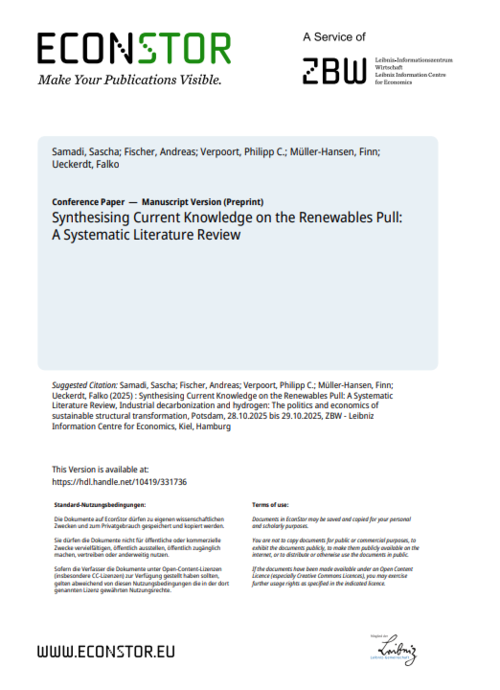
External Publication 27. November 2025 Sascha Samadi* / Andreas Fischer / Philipp C. Verpoort* / Finn Müller-Hansen* / Falko Ueckerdt* in Econstor Synthesising Current Knowledge on the Renewables Pull: A Systematic Literature Review
With the transition to renewable energy, global production cost patterns for industrial materials and products are shifting, potentially creating what has been termed the renewables pull.
Sascha Samadi* / Andreas Fischer / Philipp C. Verpoort* / Finn Müller-Hansen* / Falko Ueckerdt* in Econstor German Economic Institute (IW)
With the transition to renewable energy, global production cost patterns for industrial materials and products are shifting, potentially creating what has been termed the renewables pull.
Which refers to the attraction of industrial production activities toward regions characterised by particularly low marginal renewable energy costs. This paper conducts a systematic review to identify and synthesise the growing body of scientific literature on this emerging topic. Out of 4,813 studies screened, 81 peer-reviewed journal articles were found to be relevant. Most of these were published after 2020, with the number of publications increasing every year since then – indicating rapidly growing research interest in the field.
Most studies originate from countries such as Germany or Australia, which are also identified as a potential major importer or exporter, respectively, within newly emerging renewable-based trade patterns. In contrast, while Japan and South Korea are frequently identified as potential importers, relatively few studies originate from these countries. Most of the identified literature conducts techno-economic analysis assessing the location-specific production costs of hydrogen-based derivatives and materials such as ammonia, methanol or steel produced using solar and wind electricity. Overall, the existing literature regards the renewables pull as potentially significant, although several studies emphasise that its realised impact depends on complementary locational factors, such as financing costs and policy context.
Future research should expand the methodological approaches applied to this young and rapidly evolving field to assess the implications of the renewables pull for global production locations and value chain configurations, trade dynamics, and broader macro- and socioeconomic as well as geopolitical developments.
Reform of the EU ETS 1 and accompanying instruments
The reforms to the European Union’s Emissions Trading System (EU ETS 1) for the energy sector, energy-intensive industries, and aviation and maritime transport, due to take place in 2026, must address two key aspects in particular.
Compendium 5.7: CO2 Regulation of Road Transport in Europe
With the Compendium CO2 Regulation in Europe, the IW has been providing the interested public with a comprehensive collection of data on the development of CO2 emissions from passenger car traffic in the European Union, as well as on the applicable regulatory framework, since 2015.
Subscribe to our newsletters to receive updates on the latest IW publications. Sign up here to stay informed.
This website uses necessary cookies to ensure the operation of the website. You can allow or decline tracking. If you allow tracking, Matomo is used with cookies. You can find detailed information about the use of cookies in our privacy policy.
Warning: You are using an outdated browser!
Please switch to a modern browser (e.g. Google Chrome, Firefox or Microsoft Edge) in order to enjoy the best user experience.

 German Economic Institute (IW)