Quality of Work in Europe: An Empirical Analysis on the Basis of the EWCS 2015
IW-Report Nr. 24 21. August 2017 Andrea Hammermann / Oliver Stettes Quality of Work in Europe: An Empirical Analysis on the Basis of the EWCS 2015
Employee satisfaction signals whether employees consider the quality of their own job to be good. The share of workers in a country that are satisfied with their job is thus a measure of the quality of the jobs in an economy as a whole.
Der Link wurde zu Ihrer Zwischenablage hinzugefügt!
Andrea Hammermann / Oliver Stettes Institut der deutschen Wirtschaft (IW)
Employee satisfaction signals whether employees consider the quality of their own job to be good. The share of workers in a country that are satisfied with their job is thus a measure of the quality of the jobs in an economy as a whole.
In this context, the quality of work in the European Union and in the individual Member States is high. Around 86 percent of workers in the European Union are satisfied with their employment relationship. In Germany, this figure is slightly higher, at 88 percent. This corresponds to the figure from 2010. In many countries, particularly in Central and Eastern Europe, the level of job satisfaction between 2010 and 2015 rose from a relatively low level to a level comparable to that in Germany. Empirical evidence of a creeping deterioration in quality of work is therefore lacking both in Germany and in the European Union as a whole. There is no political pressure to act in this context.
Econometric estimates made using the Employment Samples for the European Union and Germany show that appreciation and recognition expressed in terms of money, growth perspectives and praise have greater weighting in determining whether an employee is satisfied with their job. Equally important is a good social environment in the workplace. The empirical findings also suggest that, in many places, workplace characteristics which are perceived to be generally detrimental and which in themselves are associated with a lower degree of job satisfaction are compensated by working conditions that are perceived as being supportive. As a result, quality of work is considered good by the employees in these cases when a holistic view is taken.
Inhaltselement mit der ID 2984 Inhaltselement mit der ID 2985
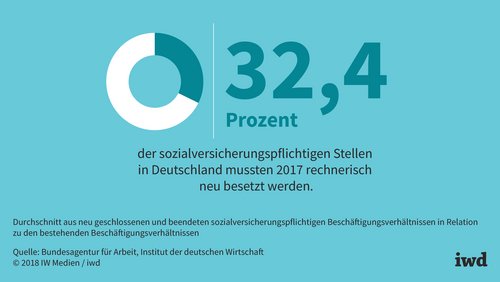
Weil Betriebe aufgrund der schwachen Konjunktur hierzulande weniger Stellen neu besetzen, kündigen weniger Beschäftigte ihre laufenden Verträge, um woanders einen Job anzutreten. Diese geringe Dynamik erschwert Arbeitslosen die Rückkehr in das Erwerbsleben und jungen Menschen den Einstieg in den Beruf.
IW-Report Nr. 14 2. April 2026 Matthias Diermeier / Konrad Doliesen / Andrea Hammermann
Gesellschaftspolitische Spannungen am Arbeitsplatz
Gesellschaftspolitische Diskussionen sind in deutschen Unternehmen weit verbreitet: Nur fünf Prozent der befragten Personalverantwortlichen berichten, diese überhaupt nicht wahrzunehmen.
Matthias Diermeier / Konrad Doliesen / Andrea Hammermann IW
Diese Website verwendet notwendige Cookies zur Sicherstellung des Betriebs der Website. Sie können Tracking erlauben oder ablehnen. Wenn Sie Tracking erlauben, wird Matomo mit Cookies eingesetzt. Detaillierte Informationen über den Einsatz von Cookies finden Sie in unseren Datenschutzhinweisen.
Achtung: Sie nutzen einen veralteten Browser!
Bitte wechseln Sie zu einem modernen Browser (z.B. Google Chrome, Firefox oder Microsoft Edge), um in den Genuss des besten Nutzererlebnisses zu kommen.

 Institut der deutschen Wirtschaft (IW)