In Brief #1: How companies should address AI in the workplace
Gutachten 26. November 2025 Jan Büchel In Brief #1: How companies should address AI in the workplace
Artificial Intelligence (AI) is a key technology with considerable economic and social potential. Companies in Europe can improve their efficiency if they succeed in deploying AI in corporate processes.
Der Link wurde zu Ihrer Zwischenablage hinzugefügt!
Jan Büchel Institut der deutschen Wirtschaft (IW)
Artificial Intelligence (AI) is a key technology with considerable economic and social potential. Companies in Europe can improve their efficiency if they succeed in deploying AI in corporate processes.
However, beside significant benefits, AI applications may also harbour risks which may counteract European values, for example if AI supports discrimination or violates people's privacy. For this reason, AI is subject to specific regulation in the EU. A comprehensive regulatory framework – the AI Act – was introduced in 2024 that focuses on harmonising various AI-related regulations and establishing a standardised set of rules across the EU. Companies in Europe that deploy or plan to implement AI must comply with this regulation. Besides the AI Act, further regulations exist that intersect with AI usage.
Steps towards a responsible use of AI in companies:
Identify the company’s AI role: - AI deployer (using purchased AI systems) or - AI provider (developing and marketing own AI systems).
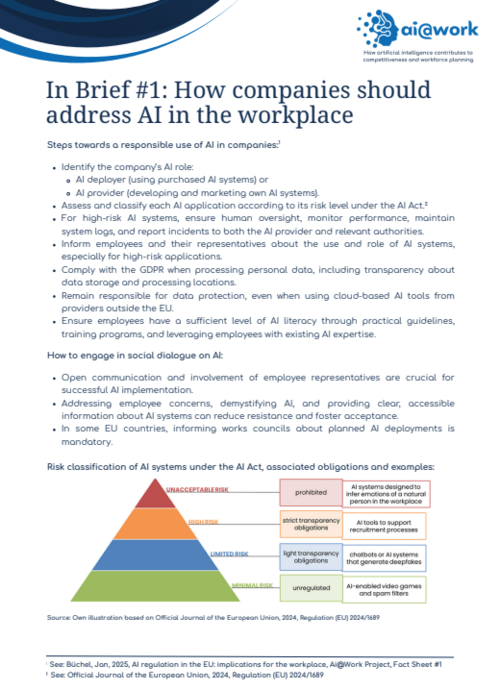
Assess and classify each AI application according to its risk level under the AI Act. For high-risk AI systems, ensure human oversight, monitor performance, maintain system logs, and report incidents to both the AI provider and relevant authorities.
Inform employees and their representatives about the use and role of AI systems, especially for high-risk applications.
Comply with the GDPR when processing personal data, including transparency about data storage and processing locations.
Remain responsible for data protection, even when using cloud-based AI tools from providers outside the EU.
Ensure employees have a sufficient level of AI literacy through practical guidelines, training programs, and leveraging employees with existing AI expertise.
How to engage in social dialogue on AI:
Open communication and involvement of employee representatives are crucial for successful AI implementation.
Addressing employee concerns, demystifying AI, and providing clear, accessible information about AI systems can reduce resistance and foster acceptance.
In some EU countries, informing works councils about planned AI deployments is mandatory.
IW-Kurzbericht Nr. 70 13. Oktober 2026 Stefanie Seele
KI-Nähe des Berufs bisher kein Nachteil auf dem Arbeitsmarkt
Die KI-nahe Beschäftigung gewinnt in Deutschland an Bedeutung. Dies liegt auch daran, dass der Beschäftigungsanteil von Fachkräften sinkt und jener von Experten und Spezialisten zunimmt.
Gutachten 29. September 2026 Jan Büchel / Jan Engler / Armin Mertens
AI and soft skills: Evidence from EU job postings
The influence of AI on the EU labour market has risen substantially in recent years. In 2025, 1.7% of job postings in the EU required in-depth AI knowledge – starting from 0.7% in 2022.
Diese Website verwendet notwendige Cookies zur Sicherstellung des Betriebs der Website. Sie können Tracking erlauben oder ablehnen. Wenn Sie Tracking erlauben, wird Matomo mit Cookies eingesetzt. Detaillierte Informationen über den Einsatz von Cookies finden Sie in unseren Datenschutzhinweisen.
Achtung: Sie nutzen einen veralteten Browser!
Bitte wechseln Sie zu einem modernen Browser (z.B. Google Chrome, Firefox oder Microsoft Edge), um in den Genuss des besten Nutzererlebnisses zu kommen.

 Institut der deutschen Wirtschaft (IW)
