With the German economy undergoing a comprehensive transformation process, the Digitalisation and Climate Action Research Unit examines how companies operate in a market environment that is evolving in line with these structural changes.
Content element with id 11156
Firms are currently being impacted by two trends in particular: digital transformation and the government’s climate policy targets. Both necessitate adjustments to business processes which require capital investments. However, these trends also represent opportunities for companies to adapt their products and services, and even their business models, and to position themselves optimally for the future.
For this to happen, it is vital that the framework conditions are set such as to ensure a functioning competition, to facilitate the founding of successful start-ups, and to promote business development. Moreover, the work of our Research Unit is based on the conviction that Germany can only develop sustainably if climate protection is pursued efficiently, energy is generated in an affordable, reliable and environmentally friendly manner and enterprises enjoy access to the necessary resources. If this succeeds, companies in Germany will be able to take advantage of market opportunities and shape their future in an attractive business location.
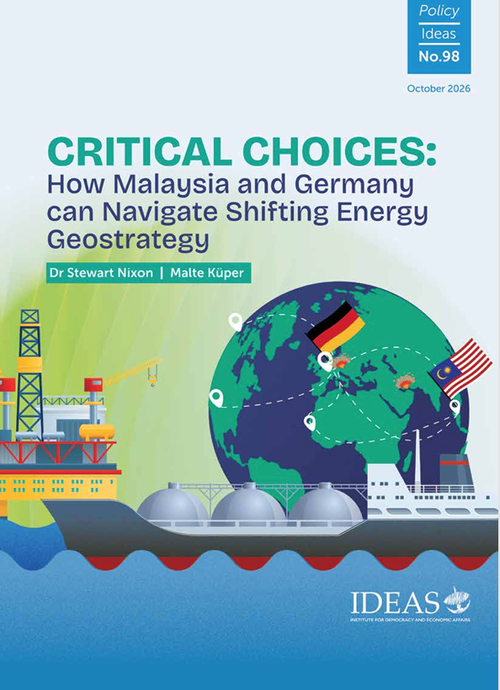
Critical Choices: How Malaysia and Germany can Navigate Shifting Energy Geostrategy
Stewart Nixon* / Malte Küper in Policy Ideas
Malaysia and Germany, as constructive and reliable participants in globally interdependent energy (as well as trade and financial) markets, face an increasingly hostile, volatile, and uncertain environment surrounding energy choices.
The German Economic Institute (IW) and Frontier Economics are pleased to invite you to a rapporteur & stakeholder workshop on the Industrial Accelerator Act (IAA) in Brussels.
Universal entitlement, unequal provision: childcare in segregated German cities
Matthias Diermeier / Jan Engler* / Melinda Fremerey / Leon Wansleben* in Journal of Social Policy
One mechanism driving persistent inequalities in childcare provision, despite rising investments and a substantial expansion of childcare facilities, may consist in the locational choices of providers, who eschew poorer neighbourhoods.
A Comparison of Public Revenues Across the Federal States
Björn Kauder
To ensure equivalent living conditions, the federal government influences the revenues of the states and municipalities. Under the fiscal equalization system, financially weak states receive surpluses in the distribution of sales tax revenues, while financially strong states must accept shortfalls.
Your search returned an incorrect status. You may have selected too many filters. You can jump back to your previous selection to adjust your search.
Content element with id 9713
IW-Newsletter
Subscribe to our newsletters to receive updates on the latest IW publications. Sign up here to stay informed.
This website uses necessary cookies to ensure the operation of the website. You can allow or decline tracking. If you allow tracking, Matomo is used with cookies. You can find detailed information about the use of cookies in our privacy policy.
Warning: You are using an outdated browser!
Please switch to a modern browser (e.g. Google Chrome, Firefox or Microsoft Edge) in order to enjoy the best user experience.