Companies are an important pillar of our economy because they create jobs, prosperity and growth. It is the task of politics to support companies in adapting to a changing environment - for example, to promote research and development.
About the topic
The structure of the German and international economy is constantly changing. Companies are challenged to adapt to new realities brought about by digitization, for example. But they are also driving innovation and thus actively shaping change. Politics can support companies in this task by setting the framework conditions favorably. This includes, for example, adjusting the rules for competition, reducing bureaucracy and always maintaining a balance between established companies, such as traditional SMEs, and startups that enrich Germany as a business location with new business models.
IW-Trends No. 2 11. July 2026 Hubertus Bardt et al.
Why Do Companies Invest in Germany?
The growth of Germany’s capital stock is slowing, as current investment increasingly fails to keep pacewith steadily rising disposals. In particular, private investment – which accounts for well over fourfifths of total gross fixed capital formation – has been alarmingly low in recent years.
Hubertus Bardt / Michael Grömling / Thomas Schleiermacher / Susanne Seyda IW
IW-Trends No. 4 26. January 2026 Hubertus Bardt et al.
The Role of the Private Sector in Germany's Overall Defence Strategy
The present study analyses the role of the private sector in Germany's national civil and military defence strategy in the light of the deteriorating security situation in Europe.
Hubertus Bardt / Simon Gerards Iglesias / Alexander Radunz / Klaus-Heiner Röhl IW
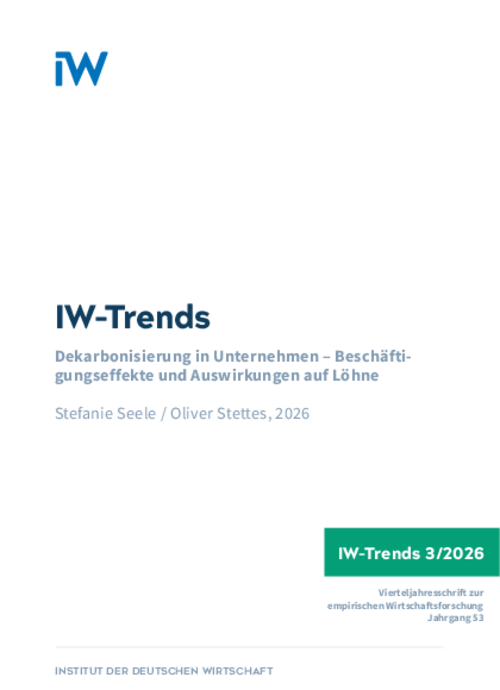
The Effects of Corporate Decarbonisation on Employment and Wages
Stefanie Seele / Oliver Stettes
While the surge in energy prices since 2022 is driving a structural change in the economy that will ultimately lead to its carbon-neutrality, job security remains high in sectors exposed to decarbonisation.
Event
11. November 2026
Alexander Radunz / Sandra Parthie
Online-Veranstaltungsreihe „Von Brüssel nach Berlin”: Der Euro als Leitwährung
Wir laden Sie herzlich zu einer weiteren Online-Veranstaltung unserer Veranstaltungsreihe „Von Brüssel nach Berlin“ ein. Mit ihr wollen wir in loser Folge Themen aus der europäischen in die deutsche Hauptstadt tragen.
Public Preferences Regarding Government Spending and Taxes
Martin Beznoska
This study examines public preferences for government spending and taxation using a fully randomised paired conjoint experiment in the 2025 IW-Population-Survey.
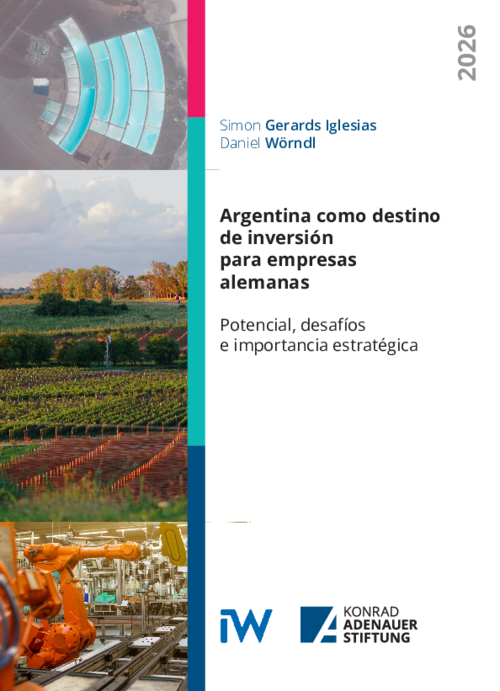
Argentina como destino de inversión para empresas alemanas
Simon Gerards Iglesias / Daniel Wörndl
Para la economía alemana, Argentina, como socio comercial y destino de inversión, ofrece más oportunidades que riesgos, ya que el país combina una política económica abierta con un considerable potencial en lo que respecta a materias primas y energía, competencia industrial y una base sólida de personal calificado.
Two years after US President Donald Trump’s re-election, the US midterm elections on November 3, 2026 offer the first nationwide referendum on his second term.
Aleksandar Vučić had led Serbia since 2014, first as prime minister and from 2017 as president, until his rule ended in October 2026 in a landslide defeat by the Student List. This report assesses the political and economic record of his twelve years in power.
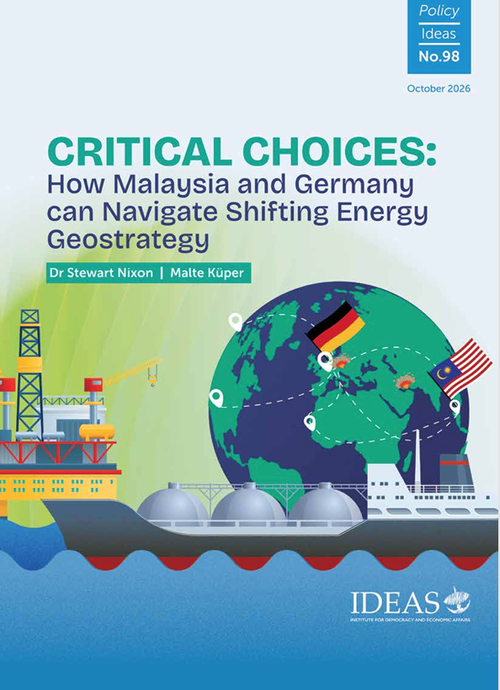
Critical Choices: How Malaysia and Germany can Navigate Shifting Energy Geostrategy
Stewart Nixon* / Malte Küper in Policy Ideas
Malaysia and Germany, as constructive and reliable participants in globally interdependent energy (as well as trade and financial) markets, face an increasingly hostile, volatile, and uncertain environment surrounding energy choices.
The German Economic Institute (IW) and Frontier Economics are pleased to invite you to a rapporteur & stakeholder workshop on the Industrial Accelerator Act (IAA) in Brussels.
Universal entitlement, unequal provision: childcare in segregated German cities
Matthias Diermeier / Jan Engler* / Melinda Fremerey / Leon Wansleben* in Journal of Social Policy
One mechanism driving persistent inequalities in childcare provision, despite rising investments and a substantial expansion of childcare facilities, may consist in the locational choices of providers, who eschew poorer neighbourhoods.
Your search returned an incorrect status. You may have selected too many filters. You can jump back to your previous selection to adjust your search.
Content element with id 9713
IW-Newsletter
Subscribe to our newsletters to receive updates on the latest IW publications. Sign up here to stay informed.
This website uses necessary cookies to ensure the operation of the website. You can allow or decline tracking. If you allow tracking, Matomo is used with cookies. You can find detailed information about the use of cookies in our privacy policy.
Warning: You are using an outdated browser!
Please switch to a modern browser (e.g. Google Chrome, Firefox or Microsoft Edge) in order to enjoy the best user experience.


 German Economic Institute (IW)