IW-Trends No. 2 11. July 2026 Hubertus Bardt et al.
Why Do Companies Invest in Germany?
The growth of Germany’s capital stock is slowing, as current investment increasingly fails to keep pacewith steadily rising disposals. In particular, private investment – which accounts for well over fourfifths of total gross fixed capital formation – has been alarmingly low in recent years.
Hubertus Bardt / Michael Grömling / Thomas Schleiermacher / Susanne Seyda IW
IW-Report No. 19 6. May 2026 Stefanie Seele / Oliver Stettes
Workplace Challenges in the Context of Ecological Change from the Employees' Perspective
Just over four in ten employees subject to social security contributions believe that their own company will come under strong pressure to change due to environmental and climate protection regulations over the next five to ten years.
IW-Trends No. 1 28. March 2026 Philipp Deschermeier / Pekka Sagner / Michael Voigtländer
Employee Housing in Germany – Growing in Importance but Faced with Persistent Obstacles
Based on a company survey conducted with the German Economic Institute’s IW Personnel Panel, this study examines the role of employee accommodation in combatting Germany’s current shortage of skilled workers and its tight housing markets.
Philipp Deschermeier / Pekka Sagner / Michael Voigtländer IW
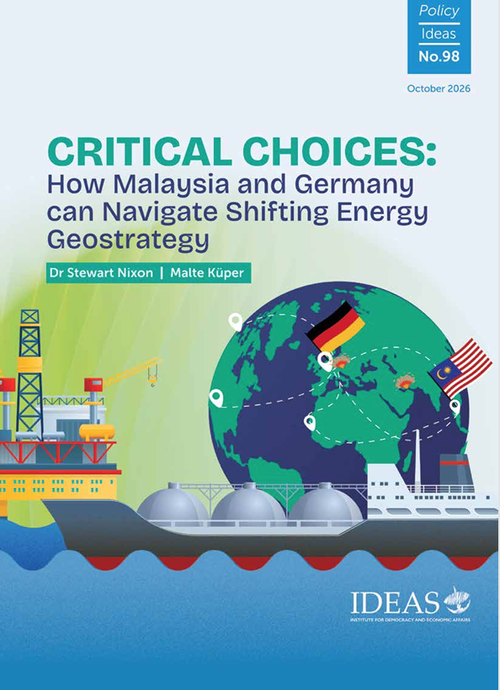
Critical Choices: How Malaysia and Germany can Navigate Shifting Energy Geostrategy
Stewart Nixon* / Malte Küper in Policy Ideas
Malaysia and Germany, as constructive and reliable participants in globally interdependent energy (as well as trade and financial) markets, face an increasingly hostile, volatile, and uncertain environment surrounding energy choices.
The German Economic Institute (IW) and Frontier Economics are pleased to invite you to a rapporteur & stakeholder workshop on the Industrial Accelerator Act (IAA) in Brussels.
Universal entitlement, unequal provision: childcare in segregated German cities
Matthias Diermeier / Jan Engler* / Melinda Fremerey / Leon Wansleben* in Journal of Social Policy
One mechanism driving persistent inequalities in childcare provision, despite rising investments and a substantial expansion of childcare facilities, may consist in the locational choices of providers, who eschew poorer neighbourhoods.
A Comparison of Public Revenues Across the Federal States
Björn Kauder
To ensure equivalent living conditions, the federal government influences the revenues of the states and municipalities. Under the fiscal equalization system, financially weak states receive surpluses in the distribution of sales tax revenues, while financially strong states must accept shortfalls.
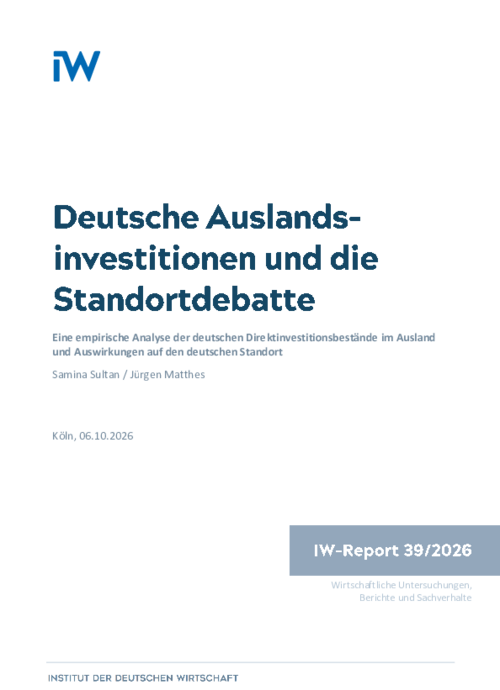
German Foreign Investment and the debate over Germany as a business location
Samina Sultan / Jürgen Matthes
Geopolitical pressure and the debate over Germany’s competitiveness make it necessary to develop a more precise understanding of German foreign direct investment. This report provides a comprehensive empirical analysis and also examines the implications for Germany as a business location.
Event
28. September 2026
Sandra Parthie / Alexander Radunz
Online-Veranstaltungsreihe „Von Brüssel nach Berlin”: Regionalentwicklung und Industriepolitik
Wir laden Sie herzlich zu einer weiteren Online-Veranstaltung unserer Veranstaltungsreihe „Von Brüssel nach Berlin“ ein. Mit ihr wollen wir in loser Folge Themen aus der europäischen in die deutsche Hauptstadt tragen.
Making Apprenticeships a Success: From Marketing to Hiring
Paula Risius / Dirk Werner / Philip Herzer / Fritz Orange / Regina Flake / Franziska Arndt / Yasin Küçükyavuz / Edgar Schmitz
In-company vocational training is a key factor in securing skilled labour. The first step in investing in future employees is to approach and recruit new apprentices. For many companies, filling the apprenticeship positions they offer is a challenge.
Your search returned an incorrect status. You may have selected too many filters. You can jump back to your previous selection to adjust your search.
Content element with id 9713
IW-Newsletter
Subscribe to our newsletters to receive updates on the latest IW publications. Sign up here to stay informed.
This website uses necessary cookies to ensure the operation of the website. You can allow or decline tracking. If you allow tracking, Matomo is used with cookies. You can find detailed information about the use of cookies in our privacy policy.
Warning: You are using an outdated browser!
Please switch to a modern browser (e.g. Google Chrome, Firefox or Microsoft Edge) in order to enjoy the best user experience.