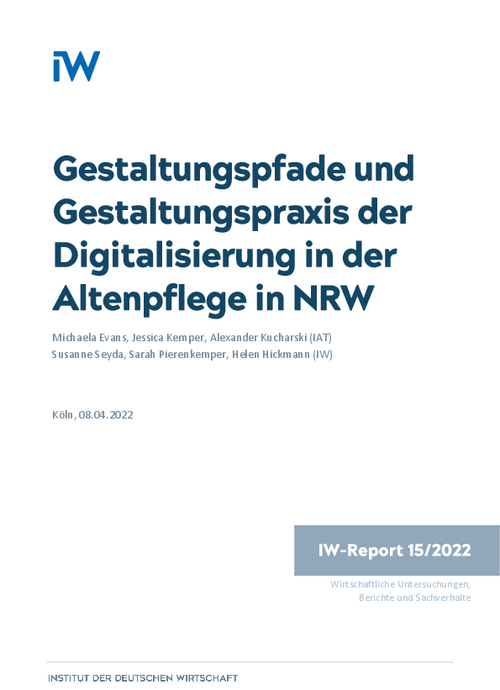
Design paths and design practices of digitalisation in elderly care in NRW
IW-Report No. 15 8. April 2022 Michaela Evans / Jessica Kemper / Alexander Kucharski / Susanne Seyda / Helen Hickmann / Sarah Pierenkemper Design paths and design practices of digitalisation in elderly care in NRW
The project "Digitalisation and Work Design in Elderly Care" focuses on company design paths and design practices of digitalisation.
Digitisation is low in the area of primary care processes in the work with and on humans, but in the area of secondary processes, digital technologies are already used more intensively in the facilities. From the point of view of the managers, it is particularly important that nursing professionals have user skills and can use subject-specific and job-specific software. In contrast, the ability to recognise interdependencies between processes is considered less relevant. It is emphasised that their training does currently not prepare nursing professionals and nursing assistants sufficiently for digitally supported care work.
Participation is understood as a core element for successfully shaping change processes, but is not yet sufficiently implemented in practice, although there exists a broad spectrum of formalised and informal participation practices. A stronger awareness of participation can possibly lead to a stronger identification with the company and bind employees more strongly to the company.
The findings of the research project are presented on a separate website www.pflege-digital-nrw.de and made available in the form of recommendations for action, checklists and self-tests for practical use.
The project is supported by Ministerium für Arbeit, Gesundheit und Soziales des Landes Nordrhein-Westfalen.
IW-Report No. 38 11. September 2026 Paula Risius et al.
Making Apprenticeships a Success: From Marketing to Hiring
In-company vocational training is a key factor in securing skilled labour. The first step in investing in future employees is to approach and recruit new apprentices. For many companies, filling the apprenticeship positions they offer is a challenge.
Paula Risius / Dirk Werner / Philip Herzer / Fritz Orange / Regina Flake / Franziska Arndt / Yasin Küçükyavuz / Edgar Schmitz IW
IW-Kurzbericht No. 96 28. November 2025 Michaelle Nintcheu
Skilled immigration via the Opportunity Card
The Opportunity Card is one of the most popular new provisions of the German Skilled Immigration Act and makes it easier for third-country nationals to access the labour market – but the regulation has been difficult to implement so far and is still unknown to many employers.
Subscribe to our newsletters to receive updates on the latest IW publications. Sign up here to stay informed.
This website uses necessary cookies to ensure the operation of the website. You can allow or decline tracking. If you allow tracking, Matomo is used with cookies. You can find detailed information about the use of cookies in our privacy policy.
Warning: You are using an outdated browser!
Please switch to a modern browser (e.g. Google Chrome, Firefox or Microsoft Edge) in order to enjoy the best user experience.

 German Economic Institute (IW)