The Impact of the Demographic Transition on the Office Real Estate Market in Germany
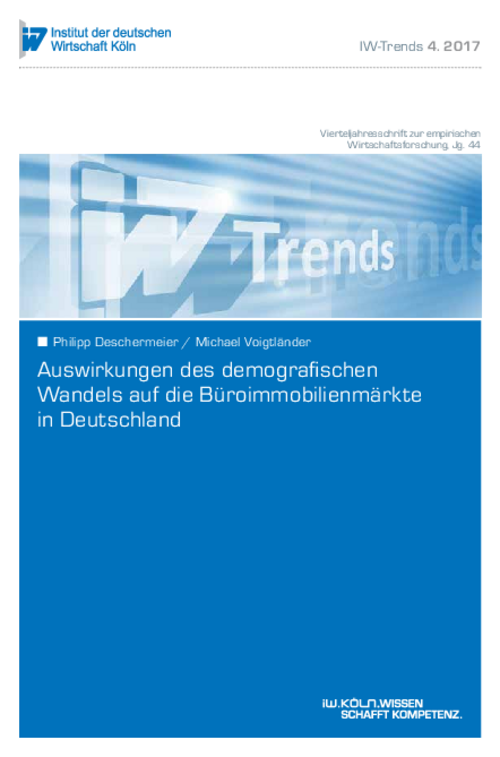
IW-Trends No. 99 31. January 2018 Philipp Deschermeier / Michael Voigtländer The Impact of the Demographic Transition on the Office Real Estate Market in Germany
With demand ultimately determined by the future number of users, the demographic transition is a significant factor in real estate investment decisions. In the market for office space, the number of office workers, itself derived from the labour force potential, is particularly important.
Philipp Deschermeier / Michael Voigtländer German Economic Institute (IW)
With demand ultimately determined by the future number of users, the demographic transition is a significant factor in real estate investment decisions. In the market for office space, the number of office workers, itself derived from the labour force potential, is particularly important.
From studies of white-collar employment and demographic trends conducted by the German Economic Institute (IW), it is possible to derive the demographic outlook for the office market up to 2035. In Germany as a whole, a short-term increase in demand for office space is expected to be followed by stagnation. However, in major cities demand will continue to rise. Especially strong growth – of between 12 and 18 per cent, depending on the scenario adopted – can be expected for Munich and Berlin, while the rates forecast for Düsseldorf, Hamburg and Frankfurt am Main up to 2035 are between 6 and 9 per cent. However, the demographic outlook for the office market is generally poorer than for residential property, since the number of economically active people is rising more slowly than the total population. Moreover, in the long run, investors must be aware of possible shifts in demand caused by factors such as digitalisation. Particularly in view of the increasing shortage of skilled labour, there is a real risk of today's office jobs being lost to automation or relocated abroad.
IW-Report No. 21 2. April 2023 Christian Oberst / Michael Voigtländer
Rental price development for commercial real estate
The commercial real estate markets are facing major challenges in view of the economic situation but also in view of structural upheavals. Against this background, this report examines the rental price development for retail and office properties.
IW-Report No. 28 18. June 2020 Michael Voigtländer
A Perfect Storm for European Office Markets? – Potential Price Effects of the Covid-19 Pandemic
The Covid-19 pandemic is not only endangering the health of people worldwide, but also causes an economic recession. Given past experiences, office markets, specifically the prime market, reacts very strongly to economic downswings. This paper attempts to derive a likely scenario for the effects in selected European office markets.
Michael Voigtländer IW
Content element with id 9713
IW-Newsletter
Subscribe to our newsletters to receive updates on the latest IW publications. Sign up here to stay informed.
This website uses necessary cookies to ensure the operation of the website. You can allow or decline tracking. If you allow tracking, Matomo is used with cookies. You can find detailed information about the use of cookies in our privacy policy.
Warning: You are using an outdated browser!
Please switch to a modern browser (e.g. Google Chrome, Firefox or Microsoft Edge) in order to enjoy the best user experience.

 German Economic Institute (IW)