Recognition of foreign professional qualifications company perspective
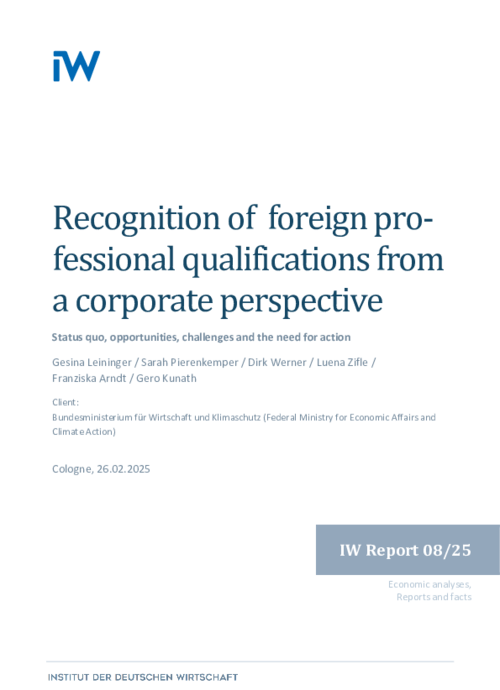
IW-Report No. 9 3. March 2025 Gesina Leininger / Sarah Pierenkemper / Dirk Werner / Luena Zifle/ Franziska Arndt / Gero Kunath Recognition of foreign professional qualifications company perspective
The report highlights the importance of recognising foreign professional qualifications for securing skilled workers from the perspective of companies in Germany.
Gesina Leininger / Sarah Pierenkemper / Dirk Werner / Luena Zifle/ Franziska Arndt / Gero Kunath German Economic Institute (IW)
The report highlights the importance of recognising foreign professional qualifications for securing skilled workers from the perspective of companies in Germany.
Recognition promotes the sustainable and qualification-based integration of skilled workers into the labour market, improves their employment opportunities and gives companies access to an expanded talent pool of professionally qualified individuals. To date, there is little knowledge about how companies perceive professional recognition, how well informed they feel about it and what action is needed from their perspective to further improve recognition procedures and support services. In order to close this knowledge gap, HR managers from a total of 815 companies were surveyed as part of the representative IW Personnel Panel on behalf of the Federal Ministry for Economic Affairs and Climate Protection (BMWK).
This survey shows that only a small proportion of companies (17.2 percent) have had practical experience with the recognition of foreign professional qualifications. At the same time, many companies categorise the topic as relevant, even if they still lack specific points of contact. Of the companies that have already had experience with professional recognition, a good half (51.6 percent) report rather negative experiences, while 39.3 percent have had positive experiences. The remaining 9.1 percent of companies cannot clearly categorise their experiences in this area. The negative experiences are mostly linked to (planned) immigration from abroad and can therefore also be influenced by other factors such as long waiting times for visas or missing state-recognised professional qualification, which prevented entry. Companies predominantly report positive experiences when it comes to the professional recognition of their own employees.
The main reasons for recognition are also related to this: The focus is on employee appreciation (72.3 percent) and long-term retention of skilled workers (71.8 percent). Other reasons for using recognition include employment in a regulated profession, for which recognised equivalence is a prerequisite, the entry of international skilled workers, the assessment of existing qualifications of (potential) employees and recognition as a prerequisite for participation in further training measures such as advanced training.
The vast majority of the companies surveyed, a good 80 per cent, state that professional recognition has not played a role in their workforce to date. The most common reason for this is the lack of contact with applicants with such qualifications or the fact that no employees appropriately qualified abroad are employed. The biggest challenges for companies are the bureaucratic hurdles and long processing times. Many small and medium-sized enterprises (SMEs) are particularly affected here, as they often do not have the necessary capacity to manage the complex recognition process. Uncertainties regarding legal requirements and procedures also hinder the use of recognition.
The professional chambers (62.8 percent) and the employment agency (51.7 percent) are the main sources that companies use to obtain information. However, companies feel there is a lack of clearly structured and easily accessible information and counselling services. For example, 65.9 percent of companies would like to see improved advisory services with specific contact persons. In addition, 63.8 percent of companies consider access to better structured and more easily accessible information on professional recognition to be helpful. Other important sources of information for companies are informal dialogue with other companies, social media or digital platforms such as the BQ portal, the portal “Recognition in Germany” and the database “anabin”, which offer valuable support with information on all aspects of the topic.
Companies have clear ideas about which measures can help them overcome obstacles in the recognition process. A key wish of companies is a faster and more transparent recognition process. Digital solutions, such as the use of artificial intelligence (AI) for document verification or better tracking of the procedure, could significantly speed up and facilitate the process from the companies' perspective. In addition, financial support measures and the dissemination of best practice examples could increase the willingness of companies to engage more intensively with the recognition of foreign qualifications.
As part of the amendment to the Skilled Immigration Act, which came into force successively in three stages from 18 November 2023 until the beginning of June 2024, new access routes were created for the recruitment of skilled workers from abroad. Although there is not yet much practical experience with this, companies generally rate the new access routes very positively: the introduction of the recognition partnership, which enables skilled workers to work in the company during the recognition procedure, is rated positively by 74.8 percent of companies. However, one in five companies is unsure about this, as many companies have no previous experience with recognising foreign professional qualifications. 61.4 percent of companies welcome the new opportunity for people with recognised professional qualifications to work in other qualified professions. Entry for a qualification analysis and the opportunity card, which enable skilled workers to find a job in Germany, are welcomed by over half of companies. Another important change is that it is no longer mandatory to have foreign qualifications recognised before entering the country if you have sufficient salary and professional experience, which is viewed positively by 47.7 percent of companies.
IW-Report No. 38 11. September 2026 Paula Risius et al.
Making Apprenticeships a Success: From Marketing to Hiring
In-company vocational training is a key factor in securing skilled labour. The first step in investing in future employees is to approach and recruit new apprentices. For many companies, filling the apprenticeship positions they offer is a challenge.
Paula Risius / Dirk Werner / Philip Herzer / Fritz Orange / Regina Flake / Franziska Arndt / Yasin Küçükyavuz / Edgar Schmitz IW
IW-Kurzbericht No. 96 28. November 2025 Michaelle Nintcheu
Skilled immigration via the Opportunity Card
The Opportunity Card is one of the most popular new provisions of the German Skilled Immigration Act and makes it easier for third-country nationals to access the labour market – but the regulation has been difficult to implement so far and is still unknown to many employers.
Subscribe to our newsletters to receive updates on the latest IW publications. Sign up here to stay informed.
This website uses necessary cookies to ensure the operation of the website. You can allow or decline tracking. If you allow tracking, Matomo is used with cookies. You can find detailed information about the use of cookies in our privacy policy.
Warning: You are using an outdated browser!
Please switch to a modern browser (e.g. Google Chrome, Firefox or Microsoft Edge) in order to enjoy the best user experience.

 German Economic Institute (IW)