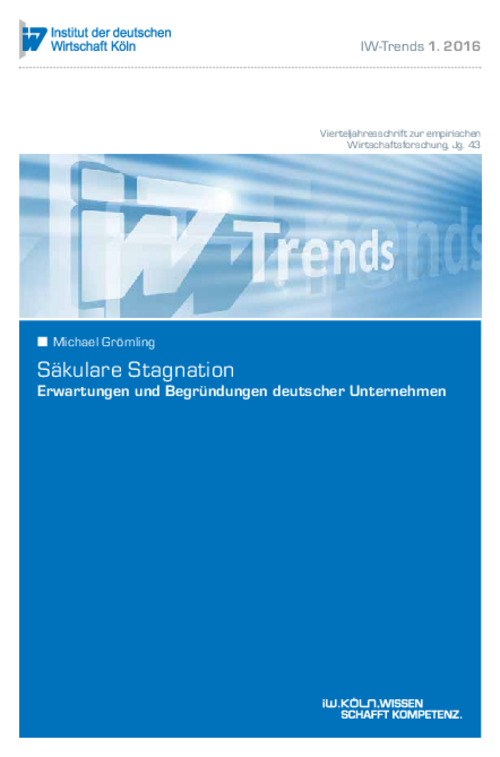
Roughly two thirds of the enterprises questioned by the Cologne Institute for Economic Research expect German economic development to remain weak. The differences between the main sectors of the economy and enterprise size are slight. Those firms which assume there will be secular stagnation see the reasons primarily on the supply side, citing the danger of a skills shortage and the costs of labour, energy and regulation, for instance. This suggests the need for an improvement in the business environment for the economy as a whole rather than a demand-side economic policy.
IW-Trends No. 2 11. July 2026 Hubertus Bardt et al.
Why Do Companies Invest in Germany?
The growth of Germany’s capital stock is slowing, as current investment increasingly fails to keep pacewith steadily rising disposals. In particular, private investment – which accounts for well over fourfifths of total gross fixed capital formation – has been alarmingly low in recent years.
Hubertus Bardt / Michael Grömling / Thomas Schleiermacher / Susanne Seyda IW
Subscribe to our newsletters to receive updates on the latest IW publications. Sign up here to stay informed.
This website uses necessary cookies to ensure the operation of the website. You can allow or decline tracking. If you allow tracking, Matomo is used with cookies. You can find detailed information about the use of cookies in our privacy policy.
Warning: You are using an outdated browser!
Please switch to a modern browser (e.g. Google Chrome, Firefox or Microsoft Edge) in order to enjoy the best user experience.

 German Economic Institute (IW)
