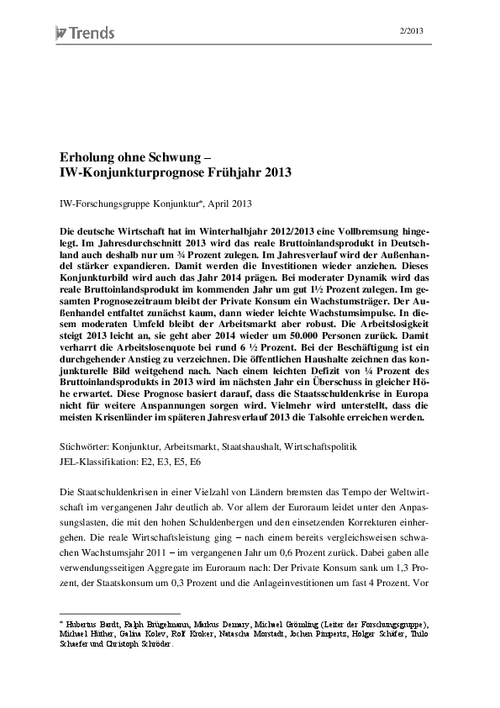
Between October 2012 and March 2013 the German economy slammed on the brakes. As a result, in 2013 real GDP in Germany will increase by an annual average of a mere ¾ per cent. Foreign trade will expand more strongly in the course of the year, leading to a rise in investment. This economic picture will continue into 2014 when, with moderate momentum, real GDP will improve by more than 1½ per cent. Private consumption remains a driver of growth over the complete forecast period. Despite this moderate environment the labour market will remain robust. Unemployment will rise slightly in 2013 but decline again by some 50,000 in 2014, leaving the jobless rate at a stubborn 6 ½ per cent. Employment is expected to show a continuous increase. The public budgets will largely reflect the overall economic picture. After a slight deficit of ¼ per cent of GDP in 2013 a surplus of the same size can be anticipated for next year. This forecast is based on the assumption that the sovereign debt crisis will not cause further tensions in Europe. Indeed, in most countries affected by the crisis the downward trend is expected to bottom out towards the end of 2013.
IW-Trends No. 2 11. July 2026 Hubertus Bardt et al.
Why Do Companies Invest in Germany?
The growth of Germany’s capital stock is slowing, as current investment increasingly fails to keep pacewith steadily rising disposals. In particular, private investment – which accounts for well over fourfifths of total gross fixed capital formation – has been alarmingly low in recent years.
Hubertus Bardt / Michael Grömling / Thomas Schleiermacher / Susanne Seyda IW
Subscribe to our newsletters to receive updates on the latest IW publications. Sign up here to stay informed.
This website uses necessary cookies to ensure the operation of the website. You can allow or decline tracking. If you allow tracking, Matomo is used with cookies. You can find detailed information about the use of cookies in our privacy policy.
Warning: You are using an outdated browser!
Please switch to a modern browser (e.g. Google Chrome, Firefox or Microsoft Edge) in order to enjoy the best user experience.

 German Economic Institute (IW)
