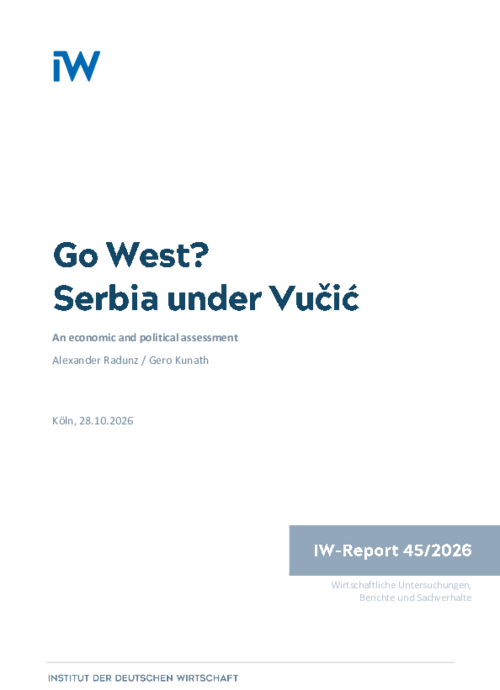
IW-Report No. 45 29. October 2026 Alexander Radunz / Gero Kunath Go West? Serbia under Vučić
Aleksandar Vučić had led Serbia since 2014, first as prime minister and from 2017 as president, until his rule ended in October 2026 in a landslide defeat by the Student List. This report assesses the political and economic record of his twelve years in power.
Alexander Radunz / Gero Kunath German Economic Institute (IW)
Aleksandar Vučić had led Serbia since 2014, first as prime minister and from 2017 as president, until his rule ended in October 2026 in a landslide defeat by the Student List. This report assesses the political and economic record of his twelve years in power.
Politically, the record shows institutional erosion. The Varieties of Democracy Institute classified Serbia under Vučić as an electoral autocracy, and Serbia ranks last among the Western Balkan countries on the Liberal Democracy Index. Transparency International's Corruption Perceptions Index fell to a historic low of 33 points in 2025. Many state-owned enterprises are run by acting directors, and large infrastructure and mining projects are often exempted from standard procurement and environmental rules. The collapse of the Novi Sad railway station canopy in November 2024, which killed 16 people, triggered the nationwide student-led protests against corruption and ultimately led to Vučić's downfall as the leader of the country.
Economically, the record is solid but not impressive. Vučić took over Serbia after a prolonged recessionary phase following the Great Financial Crisis and initiated several structural reforms for fiscal consolidation. In the following years, the Serbian economy grew strongly, the labor market improved substantially, inflation stabilized and international trade and investment relationships deepened. Since the Covid pandemic and the Russian war against Ukraine, the economic challenges increased again. Economic growth incrementally weakened, inflation took a toll on the economy and people’s livelihood and the labor market suffered from declining employment for the first time during the Vučić years. Overall, average annual growth stood at a solid 2.8 percent between 2014 and 2025.
The quality of economic growth under Vučić, however, was rather poor. Growth relied heavily on foreign private and domestic public investment, while the domestic private sector remained underdeveloped. Investment flowed mainly into traditional, low-productivity industries. The innovative strength was weak with research and development spending remaining far below the EU average. With respect to trade and investments, the EU remained the most important partner for Serbia and the ties between the two economic blocs deepened. However, China became an increasingly important actor in the country’s economy and developed several large-scale industrial and infrastructure projects. Moreover, Serbia remained critically dependent on Russian gas, which poses a strategic vulnerability. Despite some improvements of people’s livelihood due to rising wages and price stability, the financial situation of Serbian households is still strained. In addition, Serbia's economic performance under Vučić was not sufficient to close the development gap with Central and Eastern European countries, which remains at about 60 percent of their average level.
The key political challenge for the coming government lies first in the formation of a coherent political agenda and vision and ultimately in the qualitative restoration of democratic institutions. The key economic challenges for the next government are the modernization of the industrial base and strengthening of the economy’s innovative capacities, the adaptation of the labor market and social security systems to a shrinking and ageing population, as well as the diversification of energy supplies.
The German Economic Institute (IW) and Frontier Economics are pleased to invite you to a rapporteur & stakeholder workshop on the Industrial Accelerator Act (IAA) in Brussels.
Event 28. September 2026 Sandra Parthie / Alexander Radunz
Online-Veranstaltungsreihe „Von Brüssel nach Berlin”: Regionalentwicklung und Industriepolitik
Wir laden Sie herzlich zu einer weiteren Online-Veranstaltung unserer Veranstaltungsreihe „Von Brüssel nach Berlin“ ein. Mit ihr wollen wir in loser Folge Themen aus der europäischen in die deutsche Hauptstadt tragen.
Sandra Parthie / Alexander Radunz IW
Content element with id 9713
IW-Newsletter
Subscribe to our newsletters to receive updates on the latest IW publications. Sign up here to stay informed.
This website uses necessary cookies to ensure the operation of the website. You can allow or decline tracking. If you allow tracking, Matomo is used with cookies. You can find detailed information about the use of cookies in our privacy policy.
Warning: You are using an outdated browser!
Please switch to a modern browser (e.g. Google Chrome, Firefox or Microsoft Edge) in order to enjoy the best user experience.

 German Economic Institute (IW)