The Data Act: The framework companies really need for data sharing
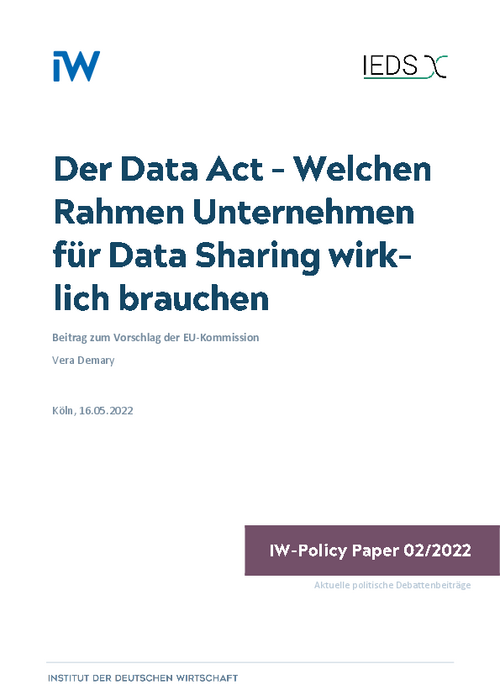
IW-Policy Paper No. 2 16. May 2022 Vera Demary The Data Act: The framework companies really need for data sharing
On February 23, 2022, the European Commission presented a proposal for the Data Act. This regulation is intended to regulate access to and use of data in the European Union in the future.
On February 23, 2022, the European Commission presented a proposal for the Data Act. This regulation is intended to regulate access to and use of data in the European Union in the future.
It includes requirements for data transfer to users of products and services that produce data, to government agencies, as well as data sharing contractual terms and cloud switching. The aim of the Data Act is to ensure that more data is available in Europe and that the potential of the data economy can be exploited. However, a balance must be struck between greater legal certainty and improved data access on the one hand and innovation and investment incentives for the manufacturers of products and services on the other. There is still a clear need for improvement in the proposal. The great complexity and depth of detail must be reduced so as not to overburden companies. The protection of trade secrets must also be given greater focus so that European companies do not lose competitiveness as a result of the Data Act.
Expertise 8. September 2026 Jan Büchel / Jan Engler / Armin Mertens
AI skills demand in the EU
More and more companies in Europe are using artificial intelligence (AI) technologies. In 2025, one in five companies in the EU with 10 employees or more used at least one major AI technology, up from 8% in 2023 (Eurostat, 2026a).
IW-Trends No. 2 15. July 2026 Jan Büchel / Jan Felix Engler / Nicolai Krüger*
AI Specialists in Public Administration – Needs and Options for Action
The use of AI in Germany’s public sector not only offers potential for efficiency gains but, in view of the sector’s shortage of skilled staff, is also urgently needed.
Jan Büchel / Jan Felix Engler / Nicolai Krüger* IW
Subscribe to our newsletters to receive updates on the latest IW publications. Sign up here to stay informed.
This website uses necessary cookies to ensure the operation of the website. You can allow or decline tracking. If you allow tracking, Matomo is used with cookies. You can find detailed information about the use of cookies in our privacy policy.
Warning: You are using an outdated browser!
Please switch to a modern browser (e.g. Google Chrome, Firefox or Microsoft Edge) in order to enjoy the best user experience.

 German Economic Institute (IW)