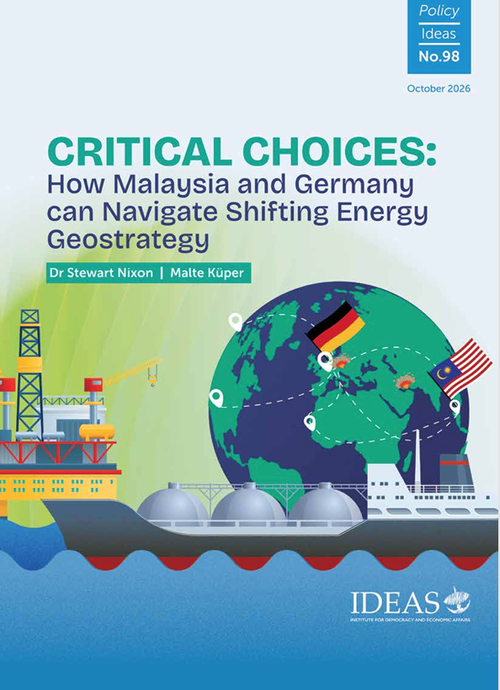
Critical Choices: How Malaysia and Germany can Navigate Shifting Energy Geostrategy
External Publication 26. October 2026 Stewart Nixon* / Malte Küper in Policy Ideas Critical Choices: How Malaysia and Germany can Navigate Shifting Energy Geostrategy
Malaysia and Germany, as constructive and reliable participants in globally interdependent energy (as well as trade and financial) markets, face an increasingly hostile, volatile, and uncertain environment surrounding energy choices.
Stewart Nixon* / Malte Küper in Policy Ideas German Economic Institute (IW)
Malaysia and Germany, as constructive and reliable participants in globally interdependent energy (as well as trade and financial) markets, face an increasingly hostile, volatile, and uncertain environment surrounding energy choices.
Major disruptions to tanker traffic in the Strait of Hormuz make a strategic reassessment of energy futures more urgent, both in a Germany (and Europe) that is still feeling the energy consequences of Russia invading Ukraine and in a Malaysia paying a high fiscal price for its politically charged reinstatement of petrol subsidies in 2018. Malaysia and Germany are caught between the destabilising forces of the United States (US), whose military and economic coercion is reshaping commodity markets, and China’s rising green manufacturing and critical minerals dominance, which risks ensnaring countries in a new form of energy technology and product dependency.
To support a shift in focus, this paper contributes to understanding recent events and how policymakers should respond to them by pursuing three related aims. It takes stock of recent changes to US energy geostrategy and explores its significance in the wider context of global energy market and policy shifts, including China’s emergence as a clean energy manufacturing superpower. It then uses the case studies of Malaysia and Germany to investigate the differing interpretation of and response to these shifts, highlighting where differences reflect understandable contextual and characteristic factors and where they instead reflect insufficient policy adaptation.
The paper then concludes by highlighting key lessons and identifying areas where Malaysia and Germany — individually, bilaterally, and as leaders of Southeast Asia and Europe — could explore further cooperation to best navigate an increasingly complicated and hostile energy geostrategy environment. The paper identifies several key areas in which to concentrate additional policy and relationship effort. The first is to develop clearer national strategies surrounding energy risk, resilience, and reward trade-offs, engaging both preparedness and response actions and developing deeper market intelligence and strategic foresight. The second is to broaden and deepen bilateral and plurilateral cooperation in pursuit of mutually beneficial and binding agreements that facilitate joint preparedness and collective shock response efforts. A third is to recognise that absorption-centric shock responses with untargeted subsidies are unsustainably expensive and blunt incentives that encourage more resilient choices. A fourth is to appreciate and guard against two distinct dependencies: traditional fossil fuel dependencies involving continuous cross-border energy flows and emerging renewable energy dependencies involving the growth or replacement of technology and products that support mostly domestic energy production. And a final fifth is that accelerating renewable energy installation is the most effective way to reduce the risk of disruptions like the prevailing West Asia crisis, with diversification a distant second and sovereign production less helpful.
Reform of the EU ETS 1 and accompanying instruments
The reforms to the European Union’s Emissions Trading System (EU ETS 1) for the energy sector, energy-intensive industries, and aviation and maritime transport, due to take place in 2026, must address two key aspects in particular.
Compendium 5.7: CO2 Regulation of Road Transport in Europe
With the Compendium CO2 Regulation in Europe, the IW has been providing the interested public with a comprehensive collection of data on the development of CO2 emissions from passenger car traffic in the European Union, as well as on the applicable regulatory framework, since 2015.
Subscribe to our newsletters to receive updates on the latest IW publications. Sign up here to stay informed.
This website uses necessary cookies to ensure the operation of the website. You can allow or decline tracking. If you allow tracking, Matomo is used with cookies. You can find detailed information about the use of cookies in our privacy policy.
Warning: You are using an outdated browser!
Please switch to a modern browser (e.g. Google Chrome, Firefox or Microsoft Edge) in order to enjoy the best user experience.

 German Economic Institute (IW)