Die wissenschaftlichen Reihen des Instituts der deutschen Wirtschaft: IW-Trends, IW-Policy Papers, IW-Analysen, IW-Studien, IW-Reports, IW-Kurzberichte und Gutachten.
Hubertus Bardt / Lennart Bolwin / Berthold Busch / Jürgen Matthes
Die Entscheidung des Vereinigten Königreichs, die Europäische Union (EU) zu verlassen, hat bisher keine Nachahmer gefunden. Mit dem Verlust der Integrationsvorteile gehen für das Vereinigte Königreich erhebliche Handelshemmnisse und wirtschaftliche Nachteile einher.
Hubertus Bardt / Lennart Bolwin / Berthold Busch / Jürgen Matthes
IW
KOFA Kompakt 5/2024:
Arbeitsmarkt geht ohne Schwung ins neue Jahr
Franziska Arndt / Gero Kunath / Dirk Werner
Die schwache konjunkturelle Entwicklung der deutschen Wirtschaft zu Beginn dieses Jahres schlägt sich auch im Arbeitsmarkt nieder. Während die Zahl an offenen Stellen im März 2024 im Vergleich zum Vorjahresmonat gesunken ist, hat sich die Zahl an Arbeitslosen erhöht. In der Folge ist auch die Fachkräftelücke zurückgegangen.
IW-Wohnindex:
Mietpreissteigerungen setzten sich fort, Kaufpreise stabiler
Pekka Sagner / Michael Voigtländer
Der vorliegende IW-Wohnindex untersucht die Entwicklung der Kauf- und Mietpreise für Wohnimmobilien in Deutschland. Der Kurzreport erscheint vierteljährig.
Sebastian Dullien* / Simon Gerards Iglesias / Michael Hüther / Katja Rietzler*
Im Jahr 2019 hatten Bardt et al. (2019) erstmalig eine umfassende Schätzung der in der damaligen Haushaltsplanung nicht abgedeckten öffentlichen Investitionsbedarfe in Deutschland vorgelegt und hatten diese Bedarfe dabei auf rund 460 Mrd. Euro über zehn Jahre beziffert.
Sebastian Dullien* / Simon Gerards Iglesias / Michael Hüther / Katja Rietzler*
IW
Transformationspolitik:
Anspruch und Wirklichkeit der Ampel-Koalition
Knut Bergmann / Matthias Diermeier (Hg.)
»Mehr Fortschritt wagen« – unter diesem Motto ist die Bundesregierung von Olaf Scholz angetreten. Schon wegen des nicht vorhergesehenen russischen Krieges gegen die Ukraine gestaltet sich dieses Vorhaben schwieriger als gedacht. Die Beiträgerinnen und Beiträger nehmen die Stellschrauben und Stolpersteine der Transformationspolitik, die sich die Ampel-Koalition vorgenommen hat, in den Blick. Damit erstellen sie nicht nur eine Halbzeitbilanz dieser Regierung, sondern geben in der Zeitenwende einen praxisnahen Überblick über die unterschiedlichen politischen Herausforderungen und ökonomischen Notwendigkeiten der Bundesrepublik.
Sarah Pierenkemper / Jennifer Potthoff / Oliver Stettes
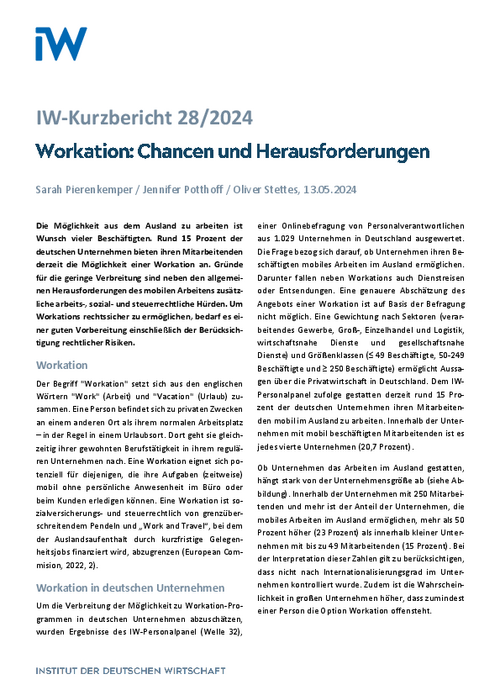
Die Möglichkeit aus dem Ausland zu arbeiten ist Wunsch vieler Beschäftigten. Rund 15 Prozent der deutschen Unternehmen bieten ihren Mitarbeitenden derzeit die Möglichkeit einer Workation an.
Sarah Pierenkemper / Jennifer Potthoff / Oliver Stettes
IW
Transformationspolitik – eine Halbzeitbilanz der Ampel-Koalition
Externe Veröffentlichung
13. Mai 2024
Transformationspolitik – eine Halbzeitbilanz der Ampel-Koalition
Knut Bergmann / Matthias Diermeier
Es hätte alles so schön werden können: Mehr Fortschritt zu wagen, hatte man sich vorgenommen; Aufbruch, Harmonie und Einigkeit – und keine Nachtsitzungen mehr, um Koalitionsstreitigkeiten zu bereinige
Die Zukunft des Westens in der Deglobalisierung – Gestaltungspotenziale trotz Abhängigkeit?
Externe Veröffentlichung
13. Mai 2024
Die Zukunft des Westens in der Deglobalisierung – Gestaltungspotenziale trotz Abhängigkeit?
Michael Hüther
Der Fall des Eisernen Vorhangs 1989/90 markierte scheinbar einen Wendepunkt in der Geschichte, weil der Wettstreit der Systeme zugunsten des Westens gewonnen war.
Für immer geteilt – kollektive Enttäuschungen trotz ökonomischer Erfolge in Ostdeutschland?
Externe Veröffentlichung
13. Mai 2024
Für immer geteilt – kollektive Enttäuschungen trotz ökonomischer Erfolge in Ostdeutschland?
Michael Hüther
Bereits acht Jahre nach der Wiedervereinigung festigte sich die Erkenntnis, dass die »wirtschaftlichen Probleme der neuen Bundesländer mittlerweile weniger spezifisch transformationspolitische Phänomene, sondern vielmehr Ergebnis allgemeiner Standortprobleme sind, die sich allerdings in den neuen Bundesländern besonders deutlich niederschlagen«.
Ihre Suche lieferte einen fehlerhaften Status zurück. Möglicherweise haben Sie zu viele Filter ausgewählt. Sie können zurück zu Ihrer vorherigen Auswahl springen, um Ihre Suche anzupassen.
Wissenschaftsverständnis
Die wissenschaftliche Arbeit des Instituts der deutschen Wirtschaft ist unabhängig und lösungsorientiert, international vernetzt und gesellschaftlich relevant, methodisch offen und interdisziplinär. Wir richten uns an die wissenschaftlichen Fachdiskurse, die breite Öffentlichkeit sowie Meinungsbildner in Politik, Wirtschaft und Gesellschaft. Wir wollen eine vernehmbare Stimme im wirtschaftspolitischen Diskurs in Deutschland sein.
Unsere Arbeit ist innovativ und stellt sich dem wissenschaftlichen Diskurs: Auf der Basis wissenschaftlich anerkannter Standards wenden wir neue Methoden an, nutzen neue Datensätze, diskutieren neue Argumente und beantworten lösungsorientiert aktuelle Fragestellungen der Wirtschaftsanalyse und Wirtschaftspolitik. Unsere Aussagen sind theoretisch fundiert und dort, wo es methodisch und empirisch möglich ist, evidenzbasiert. Wir stellen sicher, dass sowohl die Datengrundlagen als auch die methodischen Ansätze nachvollziehbar sind. Moderne Verfahren der empirischen Wirtschafts- und Sozialforschung gehören ebenso zu unseren Instrumenten wie vertiefte Analysen der institutionellen und politökonomischen Bedingungen wirtschaftlicher Entwicklungen.
Wir schließen keinen theoretischen und methodischen Ansatz aus, weil Vielfalt und Wettbewerb den Fortschritt in den Wissenschaften begünstigen. Entscheidend ist nicht ein tradiertes Paradigma, sondern ob und wie ein wissenschaftlicher Ansatz bei der Suche nach entscheidungsleitender und handlungsrelevanter Erkenntnis weiterführt. Unsere Forschung ist nicht auf die Ökonomik beschränkt, sondern anschlussfähig an die Debatten und Erkenntnisse anderer Disziplinen, wie zum Beispiel Ethik, Geschichte, Pädagogik, Politologie, Psychologie, Rechtswissenschaft und Soziologie.
Unsere Forschung ist sich ihrer normativen Bedingtheit bewusst. Jede Wissenschaft vom sozialen Handeln des Menschen bedarf einer normativen Klärung des Menschenbildes. Freiheit und (Mit-)Verantwortung sind für uns die zentralen Werte. Wir sehen den Menschen als freiheits- und verantwortungsfähiges Wesen, das in diesem Sinne zu kompetenten Entscheidungen und Handlungen befähigt und aufgerufen ist. Nach unserem Verständnis bedürfen offene, freiheitliche und demokratische Gesellschaften einer freiheitlichen und wettbewerbsorientierten Wirtschaftsordnung, die Selbstverantwortung wie Mitverantwortung zu ihren konstitutiven Elementen zählt.
Inhaltselement mit der ID 8880
IW-Newsletter
Mit unseren monatlichen Newslettern zu den folgenden Themenbereichen verpassen Sie keine IW-Publikation mehr.
Diese Website verwendet notwendige Cookies zur Sicherstellung des Betriebs der Website. Eine Analyse des Nutzerverhaltens durch Dritte findet nicht statt. Detaillierte Informationen über den Einsatz von Cookies finden Sie in unseren Datenschutzhinweisen.
Achtung: Sie nutzen einen veralteten Browser!
Bitte wechseln Sie zu einem modernen Browser (z.B. Google Chrome, Firefox oder Microsoft Edge), um in den Genuss des besten Nutzererlebnisses zu kommen.